
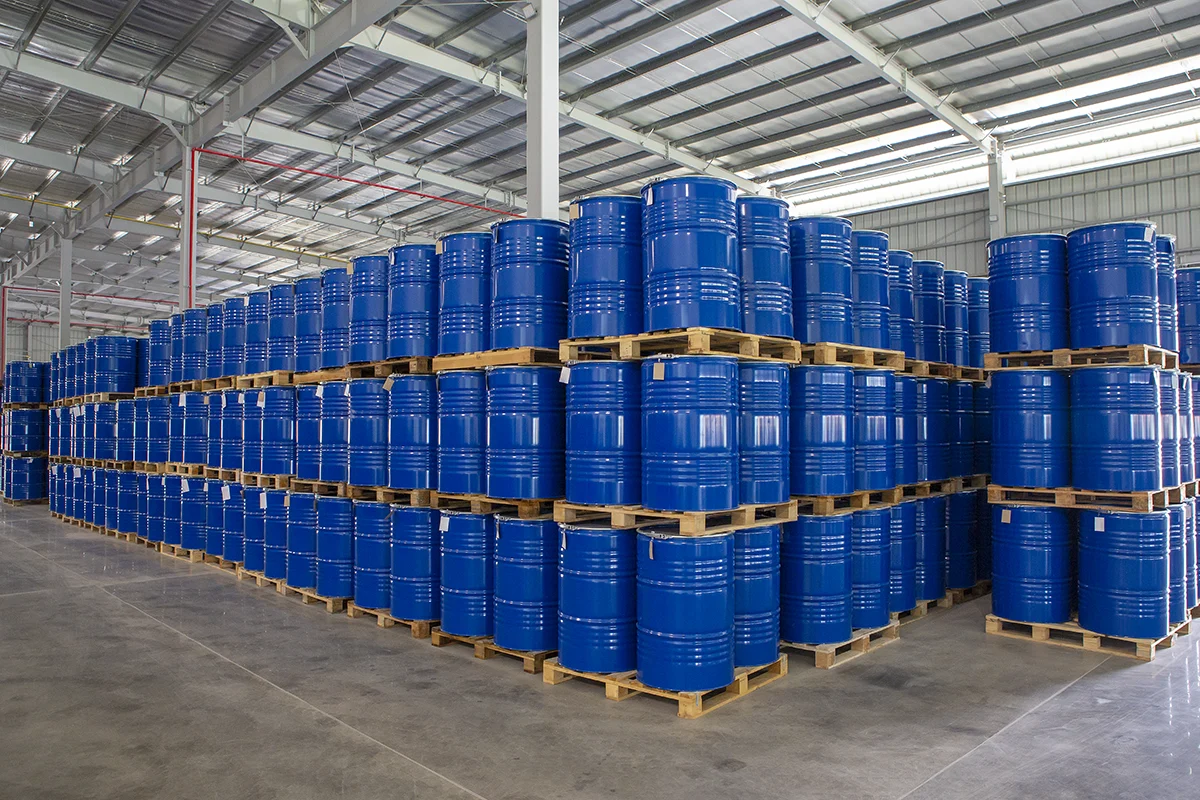
Handling 55-gallon drums is one of the more physically demanding and hazard-prone tasks in any warehouse, manufacturing, or industrial operation. A full steel drum can weigh anywhere from 400 to 800 pounds depending on its contents, and without the right equipment and technique, moving, pouring, or storing drums introduces serious risk of employee injury, product loss, and hazardous spills.
This guide covers the equipment categories and handling methods that make drum operations safer and more efficient, whether your facility works with chemicals, lubricants, food-grade liquids, beverages, or other materials in steel, plastic, or fiber drums.
Why Proper Drum Handling Equipment Matters
Manual drum handling is one of the leading causes of warehouse injuries. Rolling a drum across a floor, tipping it by hand, or attempting to pour from a full container without mechanical assistance puts employees at risk for back strain, crush injuries, and repetitive motion damage. Beyond the human cost, improperly handled drums are prone to tipping, puncture, and seal failure, all of which can result in costly product loss or hazardous spills requiring cleanup and regulatory reporting.
The right equipment eliminates most of these risks. It also improves throughput by making drum operations faster and more consistent, reducing the physical demand on your workforce and extending the useful working life of your containers.
Drum Transport: Moving Drums Safely Across Your Facility
The most common drum handling mistake is treating a 55-gallon drum like general cargo. Bare forklifts should never be used to move drums directly — the tines can puncture the drum wall and compromise the seal, particularly with thinner plastic or fiber containers. Similarly, rolling a drum manually across a floor is never a controlled operation and creates unnecessary fall and injury risk.
For ground-level transport, drum dollies and drum trucks are the standard solution. A four-wheel drum dolly cradles the drum base and allows it to be pushed or maneuvered in tight spaces with minimal effort. Paired with an ergonomic dolly handle, operators maintain control over direction and speed without direct contact with the drum body. For plastic drums, which present gripping challenges due to their smooth surface, enclosed four-wheel drum trucks provide the most stability during transport.
Two-wheel drum trucks are an effective alternative for facilities that need to move drums over longer distances or across uneven surfaces. They provide a secure grip around the drum and allow a single operator to move a full container safely.
For powered transport in larger facilities, motorized drum movers eliminate the physical effort of maneuvering heavy drums entirely. These are particularly valuable in operations that require frequent repositioning across large warehouse floors.
Forklift Drum Handling: Attachments That Protect Your Product and Your Equipment
When drums need to be moved vertically or staged on pallets, forklift drum handling attachments are the correct tool. These purpose-built attachments clamp securely around the drum body and allow the forklift to lift, rotate, and place the drum without direct fork contact with the container. This protects both the drum and its contents while giving the operator precise control over placement.
Below-hook drum handling equipment serves a similar function for facilities using overhead cranes or hoists. These attachments interface with the crane’s hook and allow safe vertical transport and placement of drums in storage racks or on elevated platforms.
For loading drums onto pallets or removing them, drum palletizers allow operators to safely raise and lower drums between floor level and pallet height without manual lifting. This is one of the most effective ways to reduce back injuries in facilities that palletize drums regularly.
Drum Pouring and Dispensing: Controlled Liquid Transfer
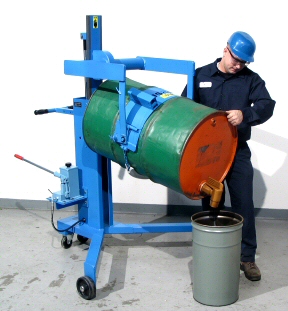 Pouring from a full 55-gallon drum manually is both physically dangerous and imprecise. The weight and awkward geometry of a full drum make tipping by hand a significant injury risk, and the lack of flow control increases the likelihood of spills and product waste.
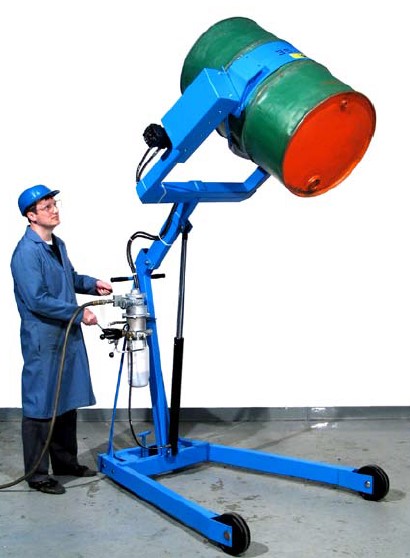
Drum cradles and tilting equipment allow controlled dispensing at adjustable angles using a mechanical crank or powered actuator. Operators can set the pour angle precisely and stop at any point, giving them complete control over flow rate without physical strain. Powered options, including battery, air, and plug-in models, reduce the effort further and are well-suited to high-frequency dispensing operations.
For facilities that need to dispense from drums at elevation, drum karriers with hydraulic or mechanical lift capability allow a drum to be raised to a dispensing height and tilted for controlled pouring. This is common in blending, filling, and batching operations where gravity-fed dispensing from an elevated position is part of the workflow.
In environments where flammable or static-sensitive materials are handled, spark-resistant and electrostatic discharge (ESD) models are available and should be specified as a standard safety requirement.
Drum Storage: Organizing and Securing Drums in Your Facility
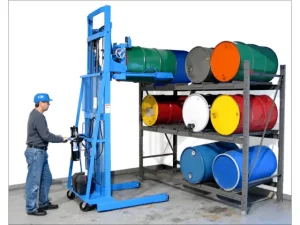 Drum storage is often an afterthought, but an unorganized drum storage area creates its own set of hazards. Drums stacked directly on floors without containment are vulnerable to tipping, difficult to inventory, and can make spill response significantly more complicated.
Drum racks and storage systems provide organized vertical storage that keeps drums secure, accessible, and properly separated. They are available in single-tier and multi-tier configurations and can be specified for steel, plastic, or fiber drum types. Containment pallets and spill containment trays positioned beneath drum storage areas are an important secondary measure for facilities handling hazardous or regulated materials, ensuring that any leakage is captured before it spreads across the facility floor.
For drums requiring rotation or mixing of contents without opening the container, drum rotators and rollers allow operators to tumble or roll drums in place. This is standard practice in paint, adhesive, and food ingredient operations where settling or separation occurs during storage.
Drum handling equipment should also account for your facility’s temperature environment. Operations in cooler or freezer storage require equipment specified for low-temperature use, as standard lubrication and component materials can fail in cold environments.
Selecting the Right Drum Handling Equipment for Your Operation
The right combination of drum handling equipment depends on several factors specific to your facility and workflow. Container type, drum weight, frequency of movement, facility layout, and the nature of the materials being handled all influence which equipment categories are most appropriate. A facility moving plastic drums of food-grade oil twice a day has different requirements than one handling daily chemical transfers in 55-gallon steel containers.
WSH works with leading drum handling equipment manufacturers, including Morse Manufacturing, Hercules, Vestil, and Wesco, to provide solutions that match your specific operational requirements. Our team conducts on-site evaluations to assess your current drum handling workflow, identify the highest-risk points, and recommend equipment configurations that improve safety and efficiency.
Get Expert Drum Handling Equipment Recommendations for Your Facility
Western Storage and Handling provides expert guidance and complete installation of drum handling equipment for warehouses, manufacturing facilities, and industrial operations throughout Colorado, Eastern Wyoming, and Western Nebraska. From drum transport and pouring equipment to organized drum storage systems, our team designs solutions built around your workflow and the specific materials your facility handles. Request a Proposal to get a customized drum handling solution for your operation.