
Pallet rack systems are engineered to carry significant loads safely over many years of operation. But that engineering assumes the rack is in the condition it was designed for — properly installed, not overloaded, and free of damage from forklift impact, wear, or human error. In a busy warehouse environment, those assumptions erode over time, often without anyone noticing until something fails.
Regular pallet rack safety inspections are the mechanism that keeps those assumptions honest. They identify damage, installation errors, and load violations before they become structural failures — protecting employees, inventory, and the long-term investment in the storage system itself.
What OSHA Requires for Pallet Rack Safety
OSHA does not publish a single dedicated standard for pallet rack inspection frequency, but several regulations create a clear obligation to maintain rack systems in safe condition. OSHA 29 CFR 1910.176 covers materials storage and requires that storage areas and equipment be kept in safe condition. OSHA 1910.178 addresses powered industrial truck operation and the requirements to protect storage structures from vehicle damage.
The Rack Manufacturers Institute (RMI) publishes ANSI MH16.1, the American National Standard for industrial steel storage racks, which is the primary technical reference for rack design, installation, and maintenance. RMI guidance recommends that rack systems be inspected at least annually by a qualified person, with ongoing employee-level inspections conducted regularly throughout the year. Many workers compensation insurance carriers also require documented rack inspections as a condition of coverage.
The bottom line is that documented, regular inspections are expected — and the absence of them creates both safety risk and regulatory exposure.
How Often Should Pallet Racks Be Inspected?
The answer depends on the operating environment. A distribution center running two forklift shifts daily in a high-SKU environment has far greater exposure to rack damage than a light manufacturing facility with minimal forklift activity. RMI guidance provides a useful framework:
Formal inspections by a qualified professional should occur at least once per year. In high-traffic, high-throughput operations, more frequent formal inspections are appropriate. Employee-level walkaround inspections should be conducted regularly — many operations build this into a weekly or shift-based safety checklist. Any time a forklift impact or collision is observed or reported, the affected rack section should be inspected immediately before returning to service.
The most dangerous scenario is not a facility that has never been inspected — it is a facility where employees see impact damage daily and consider it normal. Familiarity with a flawed system is not the same as a safe system.
The Most Common Hazards Found During Pallet Rack Inspections
WSH conducts rack safety inspections across a range of industries throughout Colorado and the Rocky Mountain region. The same categories of hazards appear consistently regardless of industry or facility size.
Damaged Uprights
Forklift impact is the most common cause of upright damage, and it is also the most consequential. An upright that has been bent, notched, or cracked by a forklift collision may look like a minor cosmetic issue but can represent a serious reduction in the upright’s rated load capacity. ANSI MH16.1 provides specific damage thresholds beyond which an upright must be taken out of service immediately — a bend or deflection that exceeds those limits is not a repair item, it is a replacement item.
The risk compounds when damaged uprights go unaddressed. A system with one compromised upright redistributes load across adjacent components, increasing stress throughout the bay. A second impact event, or simply the cumulative weight of normal operation, can trigger a cascade failure affecting multiple bays.
Damaged or Improperly Installed Beams
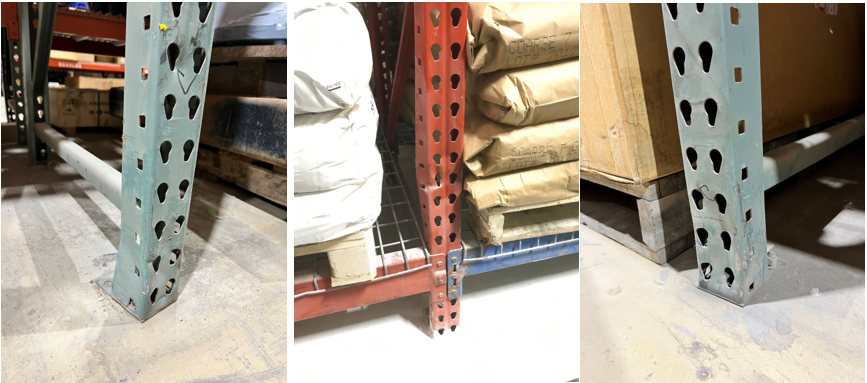
Damaged Pallet Rack Uprights
Beam damage is common in facilities where fork entry is frequent and aisle clearances are tight. Bent or cracked beams reduce the load capacity of the storage level they support. But installation errors are equally serious and often overlooked — beams that are not fully engaged in the upright connector, beams installed upside down, or safety clips that are missing or incorrectly seated all compromise the structural integrity of the connection.
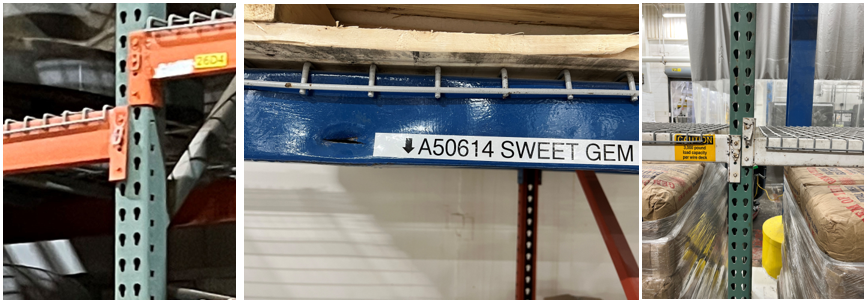
Damaged beams and improper installation
An upside-down beam, for example, places the beam’s strongest cross-section in the wrong orientation relative to the load it is carrying. It may hold under normal conditions but fail at a fraction of its rated capacity. These errors are invisible to the untrained eye and are discovered routinely during professional inspections.
Overloaded Rack Systems
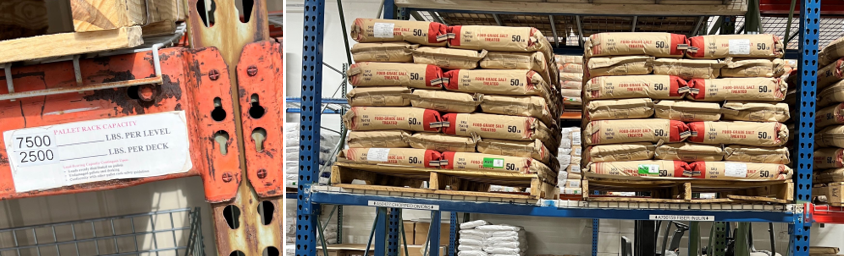
Overloaded Pallet Racks
Overloading is among the most common violations found during pallet rack inspections and is almost always a result of load planning decisions made without reference to the rack’s rated capacity. Every pallet rack system has a rated capacity per beam level and per upright bay. Those ratings are based on the specific components installed, the bay configuration, and the floor anchor system — they are not interchangeable across different rack systems or configurations.
A beam labeled to hold 7,500 pounds may, after field measurement and calculation against the installed components, be rated for significantly less. Pallet loads that exceed beam capacity cause visible deflection over time — a beam that visibly bows under load is not a warning sign, it is already a failure condition. WSH inspectors calculate actual rated capacities based on installed components and flag any discrepancy between posted capacities and real-world loads.
Incorrect or Oversized Wire Decking
Wire decking that does not match the beam span it is installed on creates load distribution problems. Decking that overhangs the beam faces, or that is positioned asymmetrically, can shift the center of gravity of a loaded pallet toward the front or rear of the rack bay, creating instability that increases the likelihood of product falling and the risk of progressive rack failure.
This issue is common in operations where wire decks have been swapped between rack systems of different configurations over time, or where replacement decking was sourced without verifying compatibility with the installed beams.
What a Professional Pallet Rack Inspection Covers
A thorough pallet rack inspection goes beyond a visual walkthrough. WSH produces detailed inspection reports organized by lane and bay that include:
Visual inspection of all uprights, beams, connectors, and guardrails for damage, wear, and deformation. Identification of components requiring immediate replacement due to safety or structural hazard. Documentation of installation errors and operational issues that must be corrected. Load capacity verification — field measurement and calculation of actual rated capacities compared to posted placards and operational loads. Wire deck compatibility assessment. Anchor inspection to confirm rack is properly secured to the floor. A comprehensive cost analysis for all recommended repairs and replacements, with priority classification.
Following the inspection, WSH can provide a full proposal for any remediation work identified, including updated floor plans, protective equipment recommendations, and guardrail or post protector additions that reduce the likelihood of future impact damage.
The Cost of Skipping Inspections
A pallet rack collapse is not simply a property damage event. Depending on the circumstances, it can mean employee injuries or fatalities, significant product and inventory loss, regulatory citations and potential facility closure, workers compensation claims, and insurance coverage disputes if inspections were not documented. The cost of an annual professional inspection is a fraction of any one of those outcomes.
Beyond the catastrophic scenario, undiscovered rack damage quietly increases the risk of product falls, forklift interference, and near-miss events that erode employee confidence in the safety of the workplace.
Schedule a Pallet Rack Safety Inspection With WSH
Western Storage and Handling conducts professional pallet rack safety inspections for warehouses, distribution centers, and industrial facilities throughout Colorado, Eastern Wyoming, and Western Nebraska. Our team produces detailed, actionable inspection reports and can handle all recommended repairs and upgrades through a single point of contact.
If your pallet rack system hasn’t been professionally inspected in the past year — or if you’ve had forklift impacts that haven’t been formally assessed — contact us to schedule an evaluation.
Request a Proposal to get started.