
Forklift impact is one of the leading causes of pallet rack damage in warehouse environments. A single collision with an unprotected rack upright can compromise the structural integrity of an entire bay — and in a worst-case scenario, trigger a progressive collapse that damages inventory, equipment, and puts employees at serious risk. Pallet rack guardrails exist to absorb and redirect those impacts before they reach the rack structure.
This guide covers how pallet rack guardrails work, the different types and configurations available, where OSHA and industry standards require them, and how to assess which system is right for your facility.
Why Pallet Rack Uprights Are Vulnerable to Forklift Impact
Pallet rack uprights are engineered to handle significant vertical load — the weight of palletized inventory stacked at multiple levels. They are not, however, designed to absorb lateral impact from moving equipment. Even a low-speed collision from a forklift or pallet jack can bend, notch, or crack an upright, creating a stress point that reduces the rack’s rated load capacity.
The challenge is geometry. In most warehouse aisle configurations, the base of rack uprights sits at or near the operating path of forklifts. End-of-row uprights and corner positions are particularly exposed because they are in the direct travel path of equipment making turns. In high-traffic facilities where forklifts operate continuously across multiple shifts, the cumulative risk of impact is significant even when operators are careful.
Damaged uprights that are not identified and replaced become a hidden liability. A rack that looks functional may be operating significantly below its rated capacity, increasing the risk of structural failure under normal load conditions.
What Pallet Rack Guardrails Do
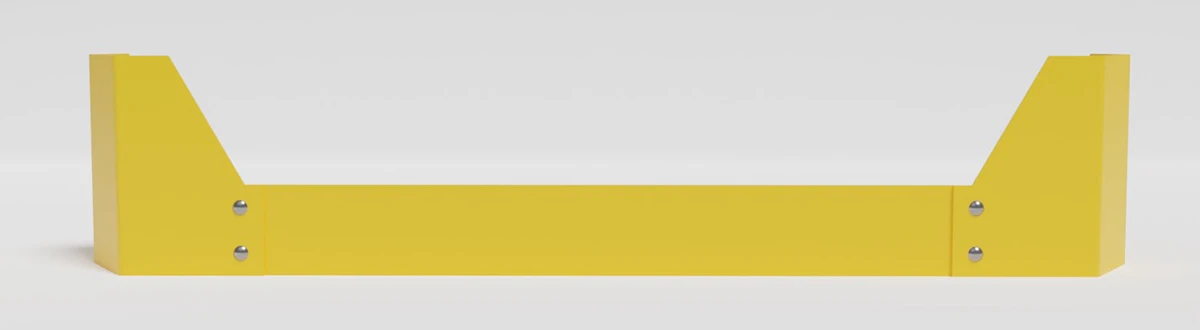
Bolted pallet rack guardrail in OSHA Safety Yellow, designed for floor-level installation in front of rack uprights to absorb forklift and equipment impact.
Pallet rack guardrails are steel barriers installed at floor level in front of rack uprights, along rack row ends, or across aisle widths to intercept and absorb forklift and equipment impacts before they reach the rack structure. Rather than allowing the energy of a collision to transfer directly into an upright, the guardrail takes the impact and disperses it through its own structure into the floor anchor.
A well-specified guardrail system does several things simultaneously. It protects the rack upright from direct contact with moving equipment. It provides a visual cue to forklift operators that marks the boundary of the rack structure and travel path. And it limits the consequences of impact events — keeping minor collisions from becoming structural damage events that require rack inspection, repair, or replacement.
Beyond rack protection, guardrails are also widely used to protect other fixed assets in warehouse environments: conveyor systems, charging stations, printer and workstation areas, electrical panels, and other equipment that cannot be relocated away from forklift travel paths.
Types of Pallet Rack Guardrails
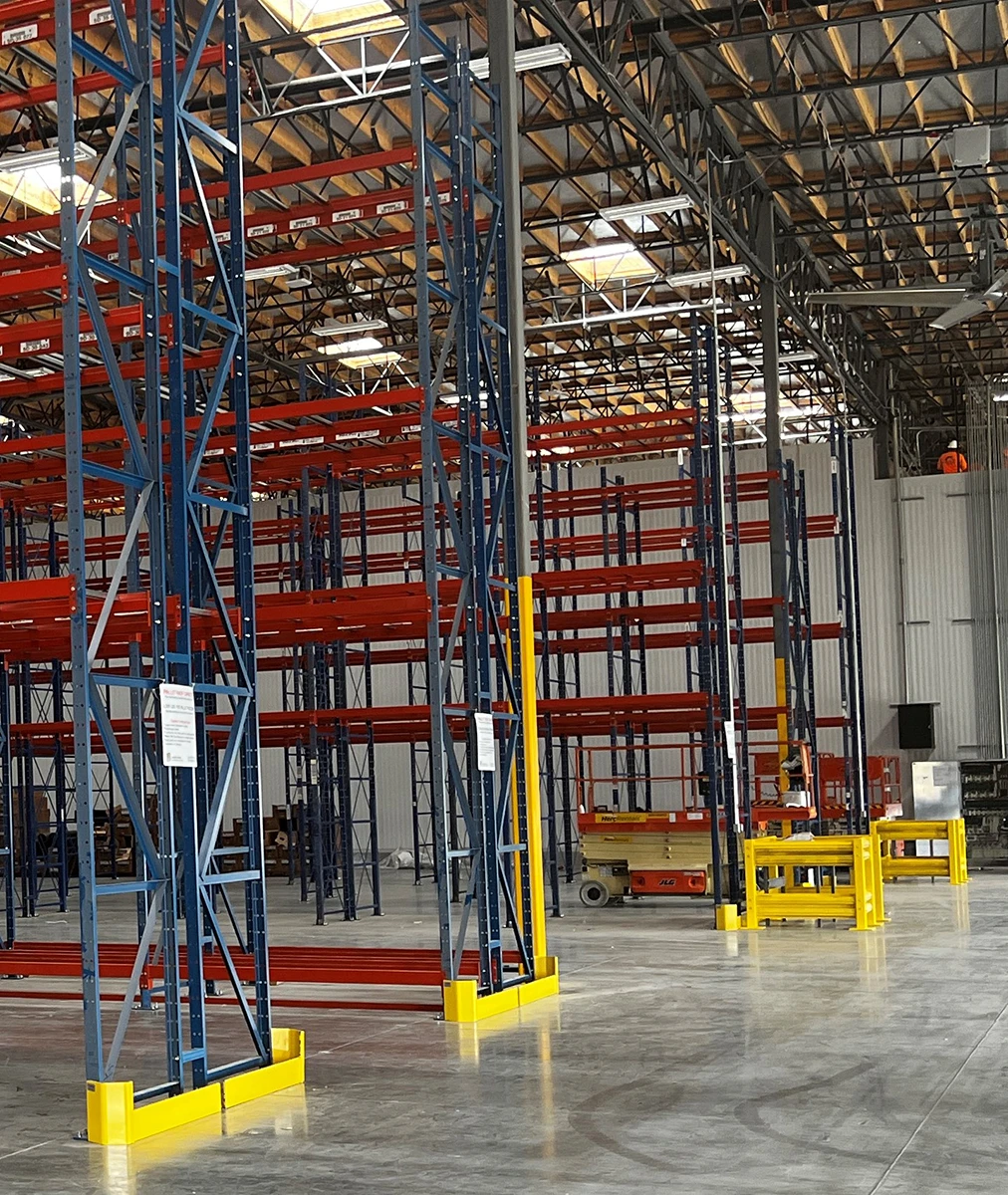
End-of-row pallet rack guardrails in OSHA Safety Yellow installed at aisle-end upright positions during a new warehouse rack installation, with bollard-protected equipment visible in the background. Both configurations protect high-exposure positions where forklift traffic is most likely to make contact with fixed assets.
Several guardrail configurations are used in warehouse environments, each suited to different positions and impact exposure levels.
Single- and double-rail post guards are the most common configuration for protecting individual rack uprights. These mount directly to the floor in front of the upright base and extend horizontally along the rack face. Single-rail guards provide basic protection for lower-traffic areas. Double-rail configurations provide additional coverage height and are better suited to facilities with high forklift activity or larger equipment.
End-of-row guardrails are specifically designed for the exposed ends of rack rows, which face the highest collision risk due to their position at aisle intersections and turning zones. These systems typically wrap around the end upright and extend along both faces of the row end to provide 270-degree protection.
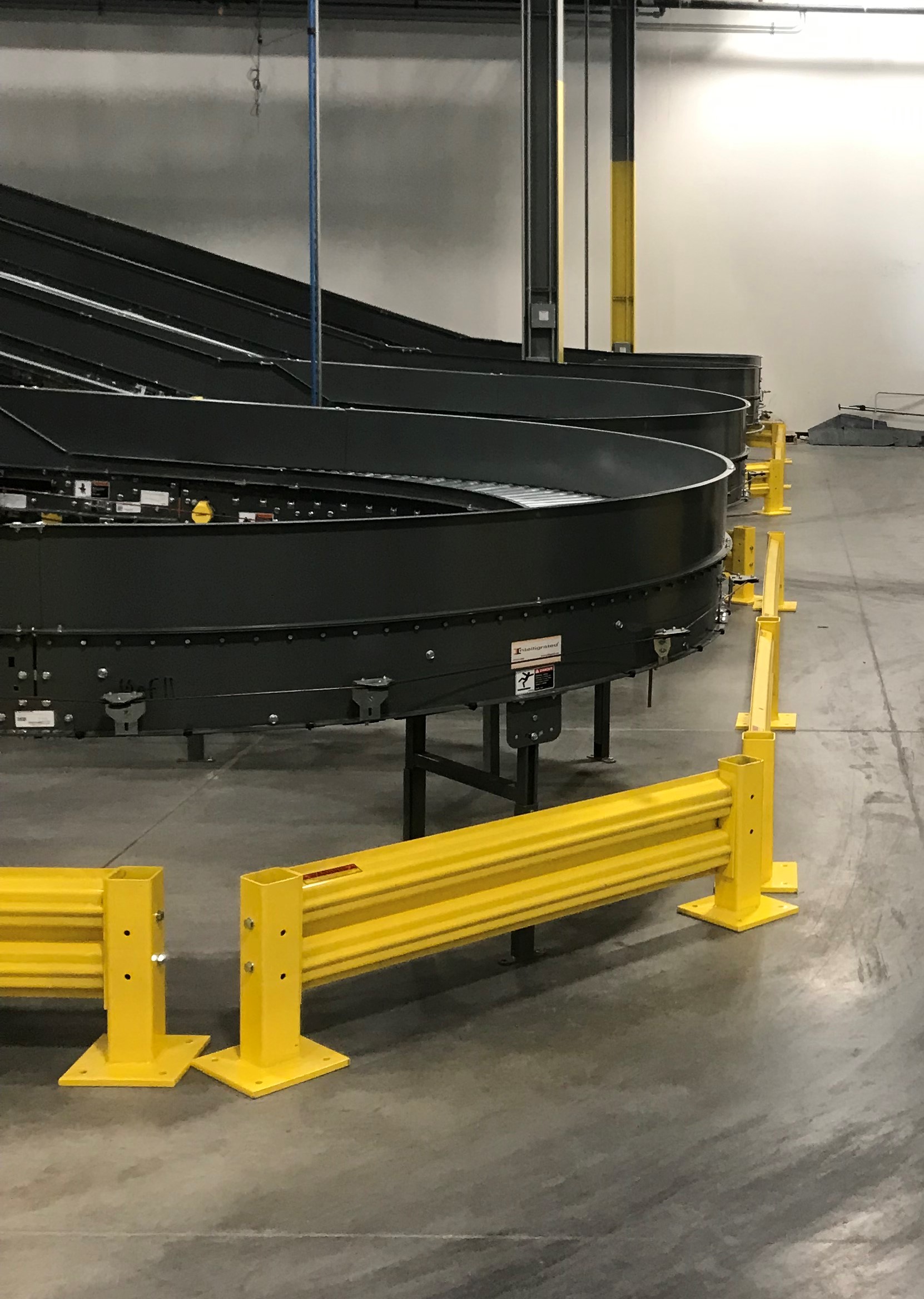 Bolted guardrail systems use a modular, multi-piece design where individual sections are bolted together rather than welded as a single unit. This approach reduces freight costs because components ship flat, simplifies on-site installation, and allows damaged sections to be replaced individually rather than replacing the entire guardrail assembly. WSH installs bolted guardrail systems from Heartland Steel — a USA manufacturer — that are available in OSHA Safety Yellow and can be ordered and installed within a 2 to 3 week timeline.
Aisle guardrails and pedestrian barriers run along the length of rack aisles to separate forklift traffic from pedestrian walkways or to define travel paths in open warehouse floor areas. These are particularly important in facilities where foot traffic and powered equipment share the same floor space.
Bollards provide point protection for individual assets — columns, fire suppression equipment, utility panels — where a continuous guardrail run is not practical. They are floor-anchored, high-visibility steel posts that absorb direct impact without transferring force to the protected asset.
Where OSHA Requires Rack Protection
OSHA’s General Industry Standards (29 CFR 1910.178) address powered industrial truck operation and include requirements for maintaining safe clearances and protecting fixed structures from vehicle impact. OSHA Standard 1910.176 covers materials storage and the condition of storage equipment.
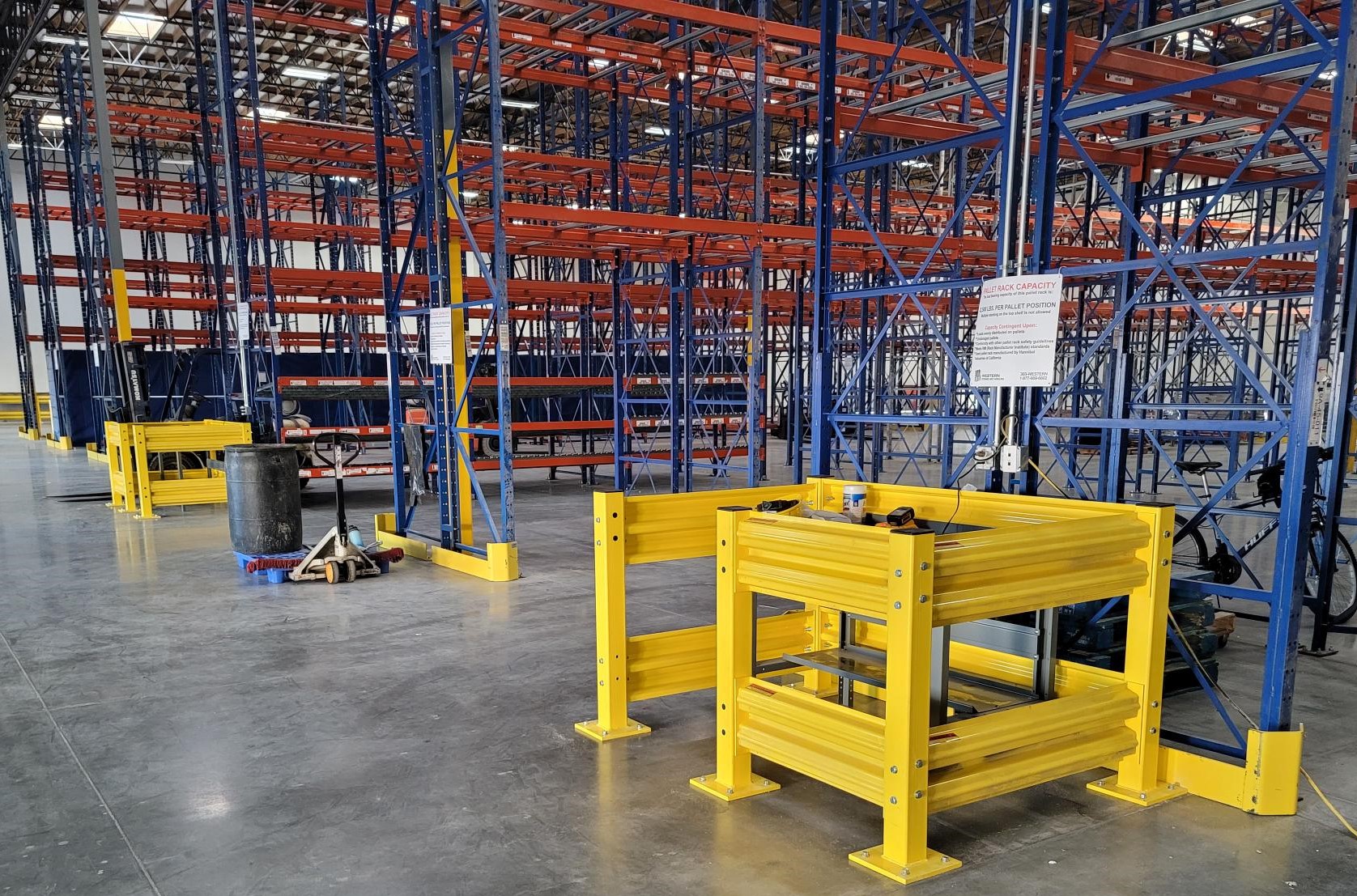
While OSHA does not prescribe a specific guardrail product or configuration, the standards create an obligation to protect rack structures from the foreseeable consequences of forklift operation in their vicinity. Many OSHA citations related to pallet rack involve damaged uprights that were not identified, reported, or addressed — a situation that guardrails help prevent by reducing the frequency and severity of impact events in the first place.
The Rack Manufacturers Institute (RMI) publishes guidance in ANSI MH16.1, the American National Standard for the Design, Testing and Utilization of Industrial Steel Storage Racks, which addresses rack protection as part of safe rack system operation. RMI guidance recommends that all rack installations include protection at aisle ends and other impact-exposed positions.
Many insurance carriers also have specific requirements for rack protection that influence coverage terms. Facilities that experience a rack collapse without documented protection measures in place may face coverage disputes in addition to the operational and human costs of the incident.
Assessing Your Facility’s Guardrail Requirements
A guardrail assessment for a warehouse facility looks at several factors: the layout of rack rows and aisle configurations, the type and size of forklifts and material handling equipment operating in the facility, traffic patterns and high-frequency travel paths, existing damage to rack uprights or previous impact incidents, and the location of other fixed assets that may require protection.
WSH conducts on-site facility assessments to evaluate where rack protection is needed and recommend the appropriate guardrail configurations for each position. Our team can identify damage to existing rack that may indicate locations with historically high impact frequency, and can coordinate guardrail installation alongside new rack projects or as a standalone safety upgrade to an existing system.
Add Pallet Rack Guardrail Protection to Your Warehouse
Guardrails are one of the highest-return safety investments available to warehouse operators. The cost of a guardrail system is a fraction of the cost of replacing damaged rack, restoring collapsed inventory, or managing the consequences of an employee injury resulting from a structural failure.
WSH supplies and installs pallet rack guardrail systems for warehouses, distribution centers, and industrial facilities throughout Colorado, Eastern Wyoming, and Western Nebraska. Whether you are outfitting a new pallet rack installation or adding protection to an existing system, our team will assess your facility and recommend a solution that meets your safety requirements and budget.
Request a Proposal to get started with a facility assessment and guardrail quote.